




FOMO has launched its in-house cross-chain bridge and trading router, claiming transactions now complete in under one second, a day after rival Pump.fun introduced its competing bridge infrastructure.
Summary
- FOMO has launched its own bridge and router, claiming cross-chain transactions now complete in under one second.
- The rollout follows Pump.fun’s competing bridge launch, with both platforms reporting faster trades and better execution.
- FOMO co-founders detailed the limited rollout and performance improvements, while liquidity and security arrangements remain undisclosed.
According to FOMO’s October 23 announcement, the social cryptocurrency trading application began rolling out the upgrade publicly after testing it with a small group of users for approximately one week. The company said the new system offers faster transactions and better execution prices, particularly during volatile market conditions.
FOMO launches bridge with sub-second cross-chain swaps
The new bridge gives FOMO direct control over how users move funds between supported blockchains, while its proprietary router handles trade execution. Previously, the platform relied on external bridging infrastructure, including Relay, to facilitate cross-chain transactions.
With the integration, FOMO says it now controls pricing, indexing, bridging and routing within its trading application. The company claims this arrangement reduces processing delays and helps traders secure more favorable prices when markets move quickly.
FOMO co-founder Se Yong Park, known as Seyong on X, explained that the team drew lessons from periods of unusually heavy trading activity on Robinhood Chain. During one such period, he said FOMO accounted for more than 50% of trading wallets on the network.
According to Park, the experience showed that traders dealing with volatile assets depend heavily on transaction speed and execution quality. The company subsequently concentrated on developing its own bridging and routing infrastructure to address both requirements.
FOMO co-founder and CEO Paul Erlanger confirmed that the infrastructure had operated in a limited release for one week before its public launch. He said the company introduced the service gradually as a safety precaution before making it available to all users.
FOMO claims 50% faster trades and better execution
The company reported that its internal bridge and router can execute trades up to 50% faster than competing systems during periods of market volatility. FOMO maintains that its average execution prices have improved by 0.5%, with gains exceeding 2% among the worst-performing 10% of trades.
FOMO further claimed that its application handles more than ten times the cross-chain transactions processed by any competing trading application. However, the announcement did not provide a complete comparison period, competitor list or independently audited transaction figures.
FOMO engineering contributor Sacha pointed to a Dune analytics dashboard comparing transaction latency across FOMO and Pump.fun. The dashboard covers routes involving Solana, Robinhood Chain, Base and BNB Chain, although the underlying numerical results require separate examination.
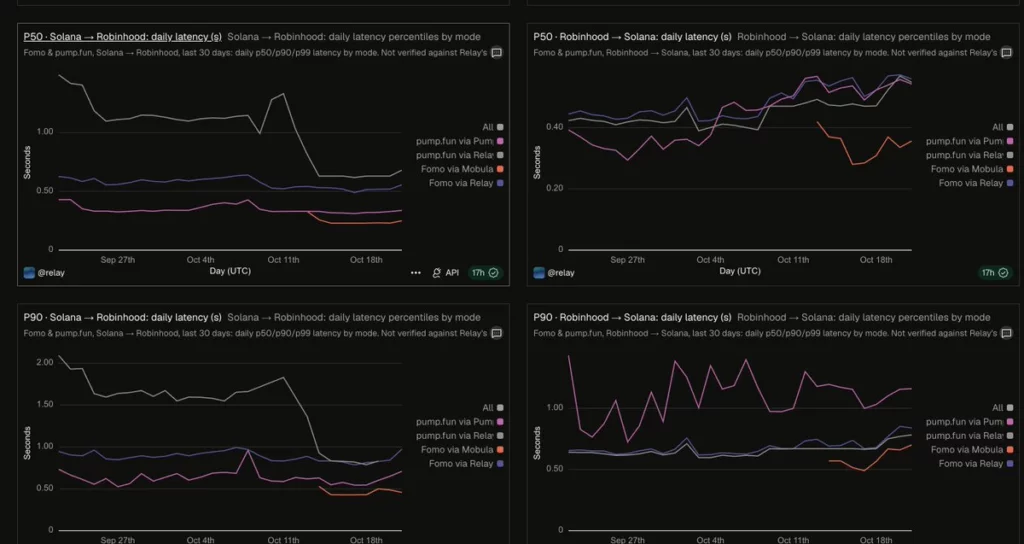
Sacha said the engineering work focused on reducing milliseconds of latency and improving execution prices. The contributor described the resulting system as potentially the fastest production method for moving funds and trading across supported networks.
Pump.fun bridge launch brings direct competition
FOMO’s announcement came shortly after Pump.fun introduced Pump Bridge as its default cross-chain trading service. As crypto.news reported on the launch, Pump.fun replaced Relay after internal testing showed improvements in execution speed and transaction reliability.
During testing conducted between September 28 and October 7, Pump.fun recorded average purchase times of 1.95 seconds through its bridge, compared with 3.88 seconds through Relay. The experiment covered more than 400,000 trade outcomes across the two routes.
Pump.fun reported a purchase error rate of 0.9%, compared with 11.2% for Relay, representing a 92% reduction. The company said its bridge currently carries no additional bridging fee, although normal trading charges may still apply.
FOMO’s sub-second claim and Pump.fun’s 1.95-second result come from different testing arrangements. Neither company has published a complete independent comparison establishing which platform performs better across identical transactions, trading volumes and network conditions.
Bridge security and liquidity arrangements remain unclear
Despite their speed claims, neither announcement fully explains which entities supply the destination-chain liquidity used to complete cross-chain trades. The available disclosures do not establish whether either platform relies entirely on its own inventory or continues using external liquidity providers.
Such arrangements carry different operational risks. A previous cross-chain bridge security analysis examined vulnerabilities involving custody, liquidity pools, verification mechanisms and the systems that authorize transfers between networks.
The companies have not disclosed enough technical information in these announcements to independently assess their bridge security models, liquidity guarantees or arrangements for failed transfers. No audit findings establishing the safety of the new infrastructure were identified in the material reviewed.
FOMO’s latest product rollout follows its $75 million funding round in June, which valued the company at $550 million. At the time, the social trading application reported more than 625,000 users and approximately $4 billion in cumulative trading volume.
