



Mastercard has expanded its payment network to support stablecoin settlements across multiple blockchains and beyond traditional banking hours, adding support for six regulated dollar-backed tokens.
Summary
- Mastercard will enable card settlement using regulated stablecoins across multiple blockchain networks, including Ethereum, Solana, and XRP Ledger.
- The company said transactions can be settled during weekends, holidays, and throughout the day while existing payment processes remain in place.
According to a statement released by Mastercard on Wednesday, the company will enable card settlement using Circle’s USDC, Paxos-issued PYUSD, USDG and USDP, Ripple’s RLUSD, and SoFiUSD. The service will operate across Ethereum, Solana, Polygon, Base, Arbitrum, Canton, Tempo, and the XRP Ledger.
Under the rollout, issuers and acquirers will be able to settle transactions during weekends, holidays, and throughout the day instead of relying solely on standard banking schedules. Mastercard said the new functionality will work alongside existing settlement processes rather than replace them.
Among the first institutions expected to support the stablecoin settlement option are ARQ, formerly known as DolarApp, CBW Bank, Cross River, Lead Bank, and Nuvei. Mastercard said the initial deployment will cover parts of the United States and Latin America, with additional expansion planned through 2026.
In its statement, Mastercard said the framework is designed to maintain the same operational standards already used across its network. The company added that security controls, fraud protections, dispute handling procedures, and interoperability features will remain in place as stablecoin settlements are introduced.
Stablecoin strategy gains momentum
Arriving weeks after Mastercard obtained a BitLicense through its subsidiary Mastercard Transaction Services (U.S.) LLC, the latest rollout builds on the company’s effort to integrate regulated digital assets into its payments infrastructure.
As reported in May, the New York State Department of Financial Services granted the license, allowing Mastercard’s subsidiary to conduct virtual currency business activity in New York. Mastercard said at the time that the authorization would support services involving stablecoins and tokenized deposits while operating under the same compliance standards applied to its traditional payments business.
Further investment followed in March when Mastercard reached a definitive agreement to acquire stablecoin infrastructure provider BVNK for up to $1.8 billion. More recently, the company granted a Mastercard Principal Membership to stablecoin card issuer Rain, adding another piece to its digital asset payments strategy.
Elsewhere in the payments industry, competitors are also increasing activity around blockchain-based settlement systems. Visa has continued testing stablecoin-linked settlement programs across multiple blockchain networks, while MoneyGram recently launched its MGUSD stablecoin on Stellar to support its international payments operations.
Data from CoinGecko shows the supply of dollar-backed stablecoins is approaching $300 billion.
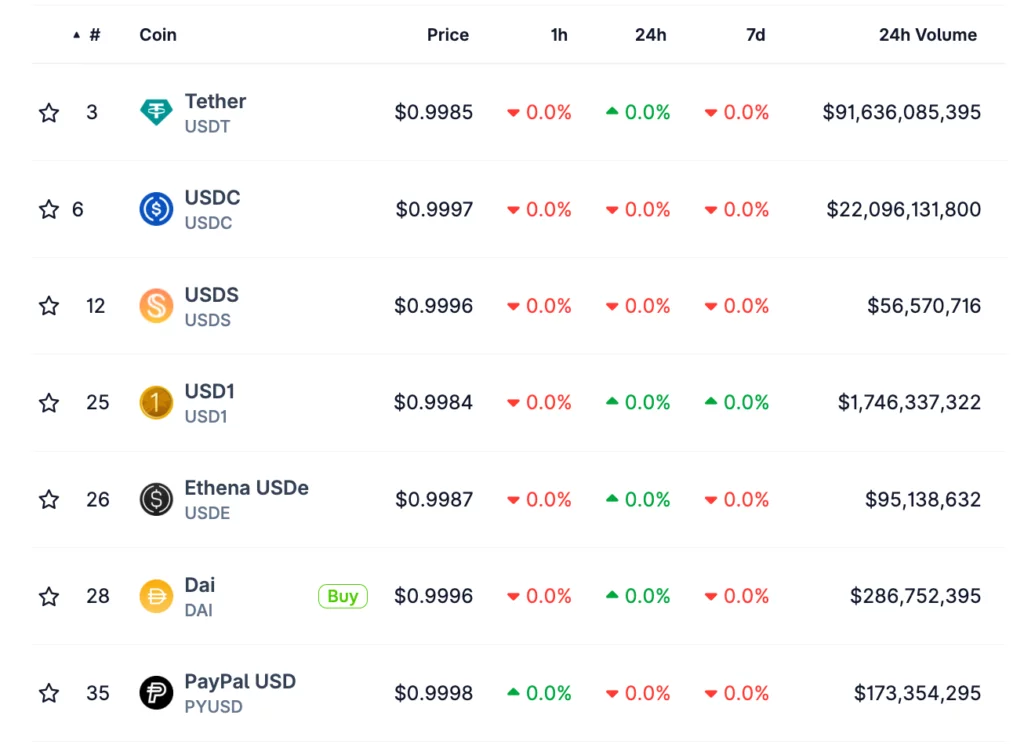
Tether’s USDT remains the largest stablecoin with roughly $188 billion in circulation, while Circle’s USDC follows with approximately $76 billion.
